1 About BEAR
January 22nd, 2026
BEAR stands for Basic Enterprise Application Realm. It runs exclusively on top of ACHE and is available free for use without warranty. The uses case for BEAR depend on whether you are an application developer or an application user.
- Developer: From the perspective of a developer, BEAR is a web application development framework. Its core concepts are:
- PHP and Javascript based
- Provides a high degree of application design structure though class files and HTML templates but has...
- Minimal level of abstraction.
- Geared towards application engineers with high levels of technical exposure.
- Template based application design.
- User: From the perspective of a user, BEAR is an application server platform for running web application towards internal and external facing consumers.
BEAR should be easy to use for any developer familiar with the LAMP stack.
1.1 Our Focus
Although BEAR is a fully fledged application development framework, our focus at AC is delivering applications for general end users and existing customers.
A Developer Toolkit is built into BEAR, but that is documented separately from BEAR.
1.2 Who Uses BEAR?
As a free for use application server, BEAR may currently be deployed in diverse sectors not known to the creators. At this time, AC have deployed this primary for use in the following areas:
- Financial software vendors
- Financial institutions (banking and securities)
- Financial institutions (market infrastructures)
- Publishing
- Education
1.3 Use Cases
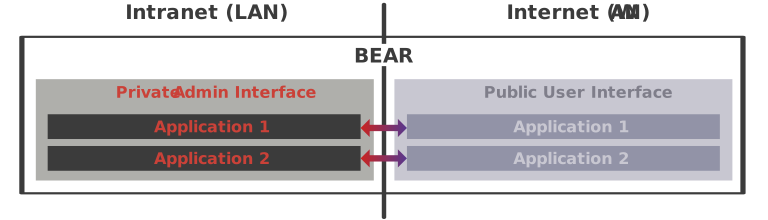
There are essentially two deployment uses cases with BEAR. The structure of BEAR provides three interfaces:
- Admin interface
- General user interface
- API interface
Application packages are available for BEAR that provide functionality that may be aimed at hosting public services on the world wide web, versus application packages for hosting internal organisation services on an intranet.
Deployment hosting world wide web facing services.
Deployment hosting intranet services.
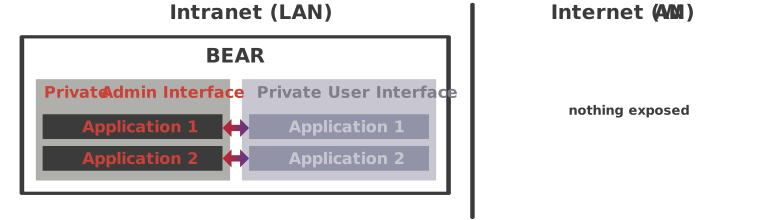
As a rule, a single deployment of BEAR should not be mixed. Application intended for an intranet would have non administrator users accessing the general user interface, but hosting fully public world-wide web applications would expose both of those to the general public which is not desirable.
If both use cases are desired, two (or more) BEAR deployments are required running on separate hosts.
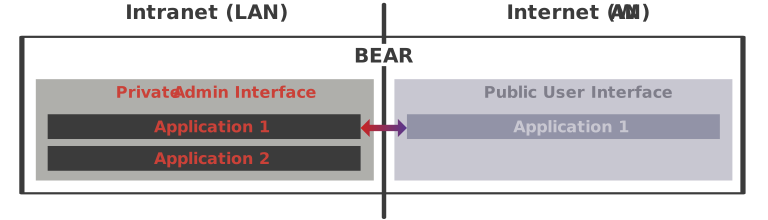
The exception to this rule would be mixing specialized applications that have only a private admin interface with applications that have both private admin interfaces and public user interfaces. BEAR DNS is an example of such an application that can theoretically run alongside internet facing applications because it has no public user interface.
Deployment with mixed intranet and internet for rare use cases.
1.4 BEAR Components
BEAR is comprised of several components which may all be installed on the same ACHE host or on separate dedicated hosts:
| Component |
Mandatory [Y/N] |
Purpose |
| Applicaiton server |
Y |
The core component that runs and serves the BEAR system and the installed application packages. |
| Database server |
Y |
Used by BEAR to handle active user sessions and event logging as well as expose a database for use by installed applications |
| File share server |
N |
Used to provide dedicated application file storage |
| Resource monitor |
Y |
Built-in to the application server, but must be installed separately on a host running a file or database server without the application server. Provides centralised system resource monitoring available from the BEAR admin interface. |
Multiple application server instances can connect to the same database or file server, either as wholly separate unrelated instances or as part of a unified cluster.